
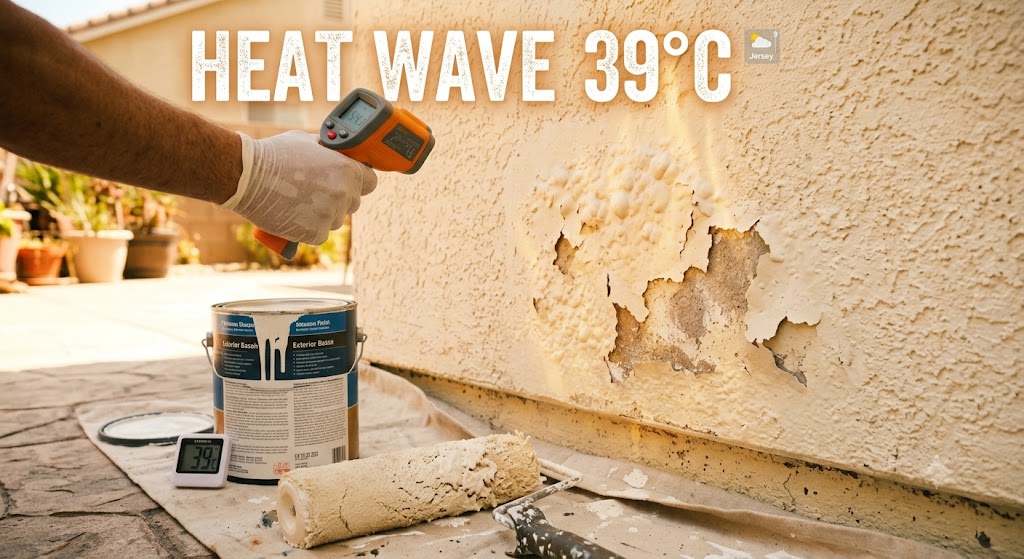
We’ve all had those projects where the client is pushing for a deadline, but when the mercury hits 39°C—like the heatwave we saw here in Jersey just yesterday—the physics of our trade work against us.
As professional decorators, we know that paint is a sophisticated chemical balance. Whether we’re using premium water-based trim enamels or high-performance wall coatings, these products are formulated to cure within a specific “comfort zone.” When we push past those limits, we aren’t just fighting the weather; we’re fighting the chemistry of the coating.
The Manufacturer’s Specification: Your Blueprint for Success
Every high-quality paint product comes with a technical data sheet (TDS) that explicitly outlines its operational temperature range. This is not a suggestion; it is a requirement for performance.
Manufacturers engineer their resins and binders to coalesce correctly only within specific temperature and humidity windows—typically between 10°C and 25°C. When we apply paint at 39°C, we are operating well outside the manufacturer’s specification. By doing so, we essentially void the product’s warranty and compromise the structural integrity of the paint film. If a job fails six months down the line, the manufacturer will point directly to the environmental conditions on-site, and we will have no recourse.
The “Flash-Dry” Reality with Water-Based Systems
Since we almost exclusively use water-based systems, we are at the mercy of evaporation rates. In 39°C heat, the water carrier evaporates at a rate the chemistry wasn’t designed for:
- Failed Coalescence: When the water evaporates too quickly, the resin particles can’t fuse properly. This results in a film that may look fine initially but lacks the scrub resistance, sheen uniformity, and long-term durability your client expects.
- The Wet Edge Battle: Your open time is effectively reduced to seconds. Maintaining a clean wet edge becomes nearly impossible, leading to visible lap marks, roller stippling, and “picture framing” that no amount of technique can fully fix.
- Surface Skinning & Solvent Popping: Applying paint to a super-heated substrate causes the surface to skin over instantly. Any moisture trapped underneath tries to force its way out, leading to micro-bubbles, pinholes, or “popping” that ruins the finish.
Prep Work in the Heat: The Hidden Failure Point
It isn’t just the paint; fillers and joint compounds also have temperature limits. When a filler “flashes” dry in 39°C heat, it loses its ability to shrink correctly and, more importantly, it loses its bond to the substrate. You’ll often find these patches cracking, shrinking excessively, or pulling away from the wall later because they didn’t have the time to cure properly.
How We Handle the Heat at Decorating Jersey
When the job can’t wait, we have to pivot our methods to maintain the quality we are known for:
- Chase the Shadow: It’s an old-school technique for a reason. We adjust our workflow to follow the building’s shaded elevations throughout the day.
- Substrate Monitoring: We use infrared thermometers to keep an eye on surface temps. If the substrate is pushing 30°C+, it is strictly outside the manufacturer’s recommended application window.
- Additive Discipline: If you’re using flow extenders, stick strictly to manufacturer limits. It’s tempting to over-thin to keep the product workable, but over-diluting “starves” the resin, which leads to adhesion failure.
- The Professional Pivot: Sometimes, the most professional decision is to have the difficult conversation with the client. Explaining that a job painted in 39°C heat is a job that risks failure in 12 months is what separates a true professional from an amateur.
For professional application, the working temperature for water-based paints generally falls within the following ranges:
- Standard Recommended Range: Most professional water-based products are designed for application between 10°C and 30°C (50°F to 85°F).
- Minimum Temperatures: While some standard products have a minimum of 10°C (50°F), specialized “low-temperature” water-based paints can often be applied at temperatures as low as 2°C to 5°C (35°F to 45°F). Always check the specific Technical Data Sheet (TDS) for your product to confirm its lower limit.
- Maximum Temperatures: Application should generally be avoided above 32°C to 35°C (90°F to 95°F). Some heavy-duty or industrial formulations may tolerate temperatures up to 55°C, but these are exceptions.
Critical Professional Considerations
Beyond just the ambient air temperature, we keep these factors in mind to ensure the finish meets professional standards:
- Substrate Temperature: The temperature of the surface you are painting is often more critical than the air temperature. Surfaces in direct sunlight can be significantly hotter than the surrounding air; use an infrared thermometer to ensure the substrate itself is within the product’s specified range.
- The Dew Point: As a rule of thumb, you should not apply water-based coatings unless the surface temperature is at least 3°C to 5°C above the dew point to prevent condensation from compromising the film formation.
- Curing Window: It is not enough for the temperature to be correct at the moment of application. Ensure the temperature remains within the acceptable range for the following 36 to 72 hours to allow for proper curing.
- Humidity: High relative humidity (typically above 80%) can impede the evaporation of water, effectively stopping the drying process even if the temperature is technically within the “safe” range.
Ultimately, decorators should be providing a high-quality, lasting finish—not just slapping color on a wall. When the chemistry and manufacturer specifications say “no,” the best tool in our kit is patience. We’ll save the project for a milder day to ensure that the work we leave behind stands the test of time.